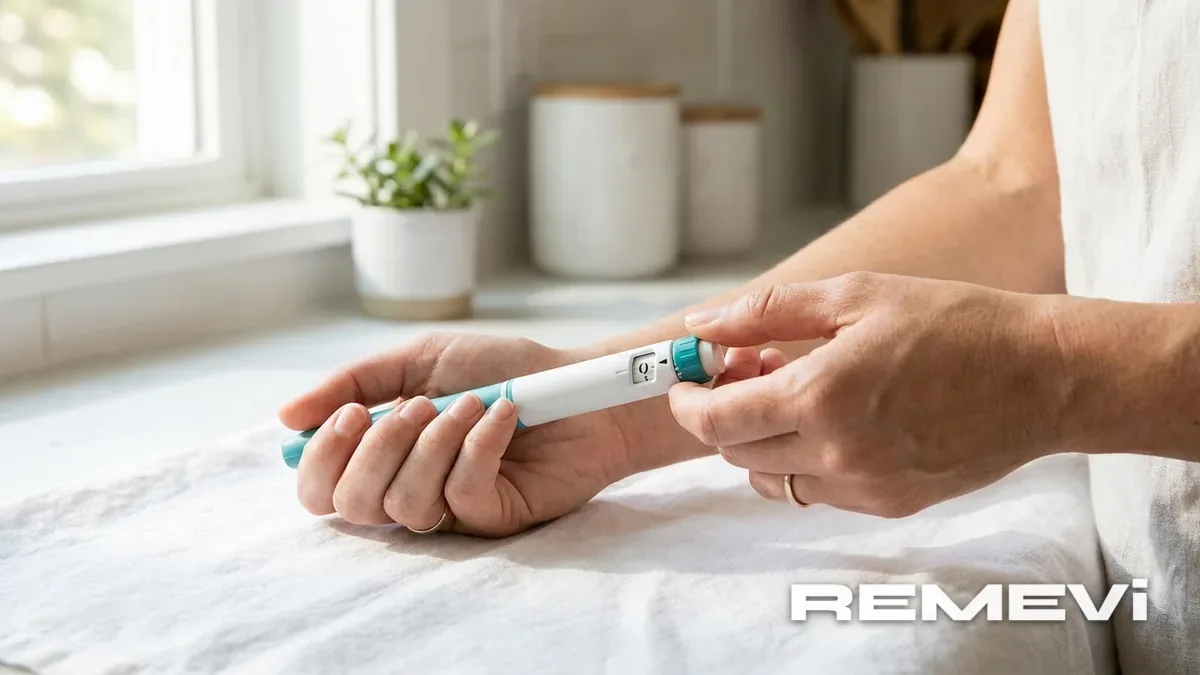
First week on GLP-1: what to expect day by day
Practical guide to your first week on semaglutide or tirzepatide — what you'll feel, how to handle the first injection, warning signs, and day-by-day tips.
The first week on a GLP-1 medication (semaglutide or tirzepatide) is the most intimidating. You’re learning how to inject yourself, your body is adapting to a new hormone, and every sensation makes you wonder “is this normal?” This guide walks you through day by day with what you can realistically expect.
Before the first injection
Prepare:
- Refrigerated medication (yes, it must live in the fridge — check your pharmacy’s specific instructions).
- Alcohol swabs.
- Sharps container for needle disposal (your pharmacy can point you to one).
- A quiet moment — don’t inject yourself rushed.
Choose the site:
- Abdomen (at least 2 inches away from the belly button)
- Outer thigh
- Back of the arm (requires help)
Rotate sites every week to avoid local irritation.
If it’s your first time with injections:
- The needle is very fine (even finer than an insulin needle).
- The injection takes 5–10 seconds.
- Pinch the skin lightly, insert at 90°, press the plunger, hold for 5 seconds, pull out.
- A drop of blood or a small bruise is normal.
Day 1 (injection day): likely no symptoms
What to expect:
- Minimal or no sensation. Many patients feel nothing in the first few hours.
- Light discomfort at the injection site that disappears within minutes.
- Occasionally: small sense of early fullness at dinner.
What to do:
- Eat normally but slightly lighter (moderate portions).
- Hydrate well.
- Avoid alcohol and very fatty foods.
- Record the exact time of the injection to keep weekly consistency.
Days 2–3: the medication starts activating
Semaglutide and tirzepatide reach peak plasma concentration between 24 and 72 hours after the injection.
What to expect:
- Early fullness more noticeable. You get full on less food.
- Possible mild nausea, especially after fatty or large meals.
- Noticeable reduction in cravings (though not every patient feels this that early in week one).
- Occasional reflux or heartburn.
What to do:
- Eat smaller, more frequent portions.
- Avoid fried, very fatty, or heavily spiced foods.
- Chew slowly to catch fullness before overeating.
- Consider ginger (natural or in tea) for mild nausea.
Days 4–5: real adaptation begins
What to expect:
- Mild to moderate nausea in some patients. Often worse right before eating.
- Possible mild fatigue.
- Constipation: very common due to delayed gastric emptying.
- Sleep possibly affected (some patients sleep better, others worse in week one).
What to do:
- If you have nausea: small meals, lean protein (chicken, fish, Greek yogurt), avoid alcohol, sip water between meals not during.
- If you have constipation: fiber + 2+ liters of water per day. Fruit (pear, kiwi), vegetables, chia.
- If you have fatigue: eat enough (no less than 1,200 calories), prioritize protein, sleep 7+ hours.
- Don’t lose motivation: this is where many patients wonder if it’s worth it. Side effects drop dramatically after the first 2 weeks.
Days 6–7: approaching the second dose
What to expect:
- Day 4–5 symptoms usually diminish.
- Fullness feels more natural — eating less starts to feel like your new normal, not restriction.
- Possible small weight loss (1–3 lb) — mostly water.
- Some patients experience a small side-effect “peak” just before the next dose.
What to do:
- Plan your second injection on the same day, preferably the same time as the first.
- Note how you felt this week: what you ate when you had nausea, what helped, what made symptoms worse.
- If you had severe effects, contact your physician before the second dose to discuss adjustments.
Warning signs (contact your physician immediately)
Not every symptom is normal. Call your physician or go to urgent care if you experience:
- Severe abdominal pain radiating to the back, with or without vomiting (possible pancreatitis)
- Persistent vomiting that prevents hydration
- Difficulty breathing or face/tongue swelling (severe allergic reaction)
- Severe pain in the upper right abdominal quadrant (possible gallbladder issue)
- Very fast or very slow persistent heart rate
- Severe dizziness or fainting
- Signs of severe dehydration (very dry mouth, dark urine, confusion)
The vast majority of first weeks pass without incident. But knowing the warning signs is part of starting any serious medication.
Practical day-by-day tips
Stay consistent:
- Same day of the week for injection.
- Regular meal times.
- Constant hydration (target: 2+ liters per day).
Prepare your kitchen:
- Accessible protein: eggs, Greek yogurt, cooked chicken breast, tuna.
- Easy fruit: banana, apple, pear.
- Pre-cut vegetables.
- Light soups for nausea days.
Avoid in week one:
- Alcohol (amplifies nausea and dehydration).
- Fried or very fatty foods.
- Large portions — your stomach processes more slowly, overeating causes discomfort.
Track what matters:
- Weight (not daily — once a week is enough).
- General energy.
- How you feel emotionally.
- Side effects and when they occur.
When to escalate to the next dose
The second injection, a week later, is typically the same dose (week 2 of the starting dose). Doses increase every 4 weeks per the titration protocol, always under medical supervision.
At REMEVi we review your progress monthly and adjust dose based on tolerance and results — not automatically, but with individual evaluation.
Frequently asked questions
What if I miss an injection?
If you miss a dose and it’s less than 5 days until the next one, take it as soon as possible. If it’s less than 2 days, skip that dose and continue the normal schedule. Never double up.
Can I fly with the medication?
Yes. Travel with the medication in carry-on luggage (not checked) and a small cooler to maintain temperature. TSA allows prescription liquid medications.
When do I start seeing real weight loss?
First week: 1–3 lb (mostly water). First 4 weeks: 3–6 lb. The real pattern starts between month 2–3 when you reach higher doses.
Is it normal to feel emotionally different?
Some patients report mild mood changes in the first few weeks — usually from altered sleep or energy. If you notice deep sadness, intrusive thoughts, or significant mood changes, tell your physician.
At REMEVi
Your first month with REMEVi includes:
- Complete initial consult with a bilingual physician.
- Education on how to inject properly (video included in English and Spanish).
- Direct message access to your clinical coordination team for week-one questions.
- Medical review at the one-month mark to adjust dose.
Start the quiz · GLP-1 side effects — complete guide · Semaglutide: complete guide
This information is educational and does not replace individual medical guidance. Last medical review: April 19, 2026.
¿Hablas español?
Esta guía también está disponible en español, escrita por el mismo equipo médico bilingüe.
Lee este artículo en españolReady to get started?
5-minute intake. Physician review in 24 hours. Medication delivered to your door.
Start Free Consult →No insurance required · Cancel anytime · Bilingual support