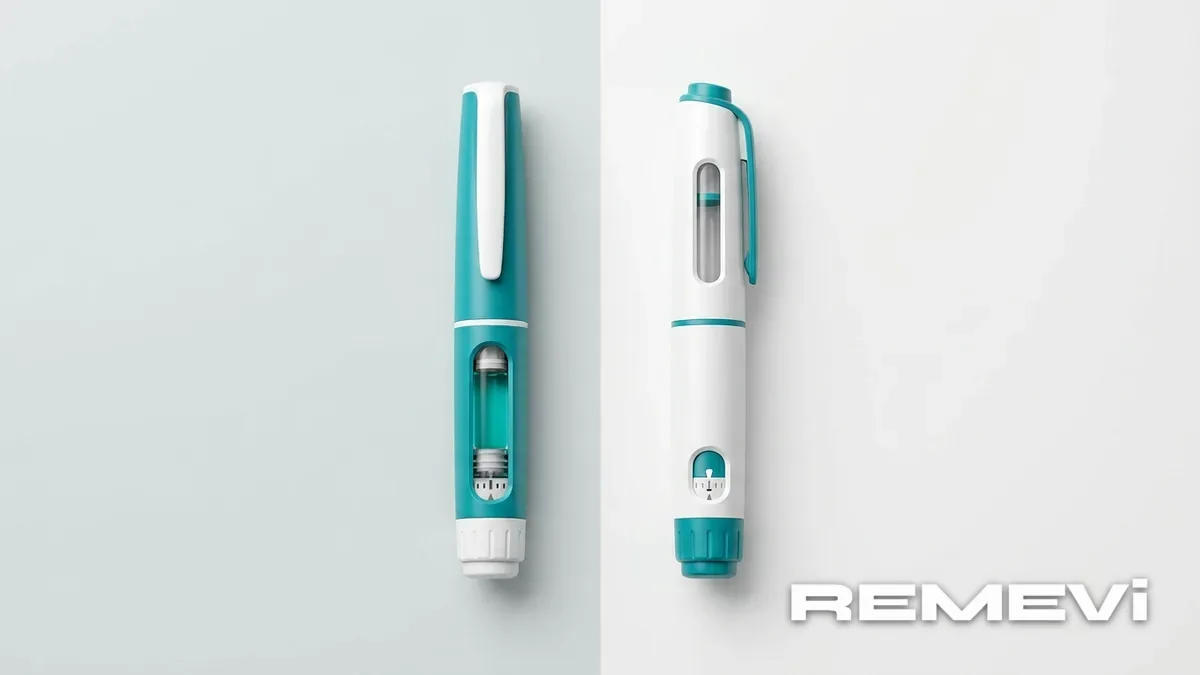
Ozempic vs. REMEVi: Why Patients Are Switching
Why patients are switching from Ozempic to compounded semaglutide — cost, access, convenience, and the honest comparison between brand and telehealth.
If you’ve spent the last year wrestling with Ozempic — calling pharmacies that don’t have it, paying $1,000 a month out of pocket, or arguing with your insurance company about prior authorizations — you are very much not alone. The same medication that turned weight loss medicine on its head has also become one of the most frustrating prescriptions in modern healthcare. Patients want it. Doctors prescribe it. And then real life happens: shortages, denials, and price tags that look like a car payment.
That friction is why a growing number of people are switching from brand-name Ozempic to compounded semaglutide through telehealth providers like REMEVi. The active ingredient is the same molecule. The access model is completely different. And for a lot of patients — especially those without commercial insurance, Spanish-speaking households, and people who simply do not want to keep driving to a pharmacy that may or may not have product on the shelf — the math has tipped.
This guide is the honest comparison. Not the marketing version. We’ll cover what Ozempic actually is, what compounded semaglutide actually is, where the two are the same, where they meaningfully differ, and how to decide which one belongs in your life.
What Ozempic Actually Is
Ozempic is the brand name for semaglutide manufactured by Novo Nordisk, originally FDA-approved in 2017 for type 2 diabetes. The drug is a GLP-1 receptor agonist — it mimics a hormone your gut releases after meals to slow digestion, regulate blood sugar, and reduce appetite. Wegovy is the same molecule from the same manufacturer, dosed and labeled specifically for weight loss.
When clinicians and patients say “Ozempic for weight loss,” they are typically describing off-label use of the diabetes formulation, or the brand-equivalent Wegovy. The medication is delivered as a once-weekly subcutaneous injection from a pre-filled pen, escalated from 0.25mg up to 2.4mg over the course of months.
The clinical results are well documented. The STEP trials — a series of large randomized studies — showed roughly 14.9% average body weight loss at 68 weeks for adults with obesity using semaglutide 2.4mg, compared to about 2.4% for placebo. That is a real, durable, biology-shifting effect, not a fad.
The problem has never been the drug. The problem has been getting it.
Where the Ozempic Experience Breaks Down
Three things make brand-name Ozempic difficult for most American patients in 2026.
Cost. Without insurance coverage for weight loss, the cash price for Ozempic typically runs $950 to $1,350 per month depending on pharmacy, region, and dose. Wegovy is similar or higher. Manufacturer savings cards often exclude cash-pay patients, exclude Medicare and Medicaid recipients, and have hard caps. A year of treatment can easily exceed $12,000 out of pocket.
Access. The FDA’s drug shortage list has had semaglutide on and off it for the better part of three years. Even now, with manufacturing scaled up, regional shortages still happen. Patients describe calling five or six pharmacies, waiting weeks for a refill, or being told to switch doses just to find something in stock.
Friction. A traditional prescription means an in-person primary care visit, a specialist referral in some cases, prior authorization paperwork, a separate trip to a pharmacy, and the hope that your specific dose is available. None of that fits a working parent’s schedule. None of it is bilingual by default.
Patients aren’t switching to compounded semaglutide because they think it’s clinically superior. They’re switching because the brand pathway is broken for the majority of people who need it.
What Compounded Semaglutide Is — and What It Isn’t
Compounded semaglutide is semaglutide produced by a state-licensed compounding pharmacy rather than by Novo Nordisk’s brand manufacturing line. It is the same active pharmaceutical ingredient — semaglutide — formulated, sterilized, and dispensed under United States Pharmacopeia (USP) standards by a pharmacy regulated by state boards of pharmacy and, for larger 503B outsourcing facilities, by the FDA.
A few things compounded semaglutide is not, and we want to be clear about this:
- It is not an FDA-approved finished drug product the way Ozempic and Wegovy are.
- It is not a generic in the formal regulatory sense — there is no FDA-approved generic semaglutide on the market today.
- It is not legal to compound just because a patient prefers the price; compounding pharmacies operate under specific federal and state rules, and recent FDA guidance on shortages has narrowed when compounded GLP-1s can be produced.
What it is, when sourced responsibly, is the same molecule produced under regulated pharmacy practice, prescribed by a licensed physician after an individualized medical assessment, and dispensed for a specific named patient.
The honest framing: brand-name Ozempic carries the full weight of FDA finished-drug approval, manufacturer pharmacovigilance, and decades of corporate clinical infrastructure. Compounded semaglutide carries the regulatory weight of pharmacy-level oversight and the prescriber’s clinical judgment. Both pathways are legal. They are not the same thing. Patients deserve to understand that distinction before choosing.
Side-by-Side Comparison
A few of the most common questions, answered as plainly as we can.
Cost
Brand-name Ozempic without insurance coverage for weight loss: typically $950–$1,350 per month, with limited manufacturer assistance for cash-pay patients.
REMEVi compounded semaglutide:
- $249 per month on a monthly plan
- $219 per month on a 12-week commitment
- $199 per month on a 24-week commitment (our most popular plan)
- $179 per month on a 52-week commitment
That price is all-inclusive — medication, pre-filled syringes, needles, alcohol pads, shipping, and physician oversight. There are no surprise pharmacy fees and no separate visit costs.
The Active Ingredient
Same molecule: semaglutide. The mechanism of action — slowing gastric emptying, regulating glucose, reducing appetite signals — is identical. Patients report similar onset (appetite changes within the first one to two weeks) and similar weight loss trajectories when titrated to comparable doses.
Delivery and Dosing
Brand Ozempic comes in a pre-filled multi-dose injector pen with fixed dose options.
Compounded semaglutide is typically dispensed in vials with separate syringes, allowing the prescribing physician more flexibility on titration (for example, a 0.375mg dose between standard pen settings if a patient is sensitive to escalation). REMEVi ships everything in one package. Most patients learn the injection in under five minutes.
Insurance vs. Cash Pay
Brand Ozempic relies heavily on insurance coverage. If your plan covers it for diabetes, your copay can be reasonable. If your plan doesn’t cover it for weight loss — which is most plans, most of the time — you are paying near-full retail.
REMEVi is cash-pay only. We do not bill insurance. The trade-off is simplicity: one transparent monthly price, no prior authorizations, no surprise EOBs, no benefits department to call. For patients without coverage, that’s usually a relief. For patients with strong coverage that already pays for Wegovy, brand may still be the better economic choice.
Access and Refills
Brand Ozempic depends on whether your local pharmacy has it in stock at your dose. Refills can take days to weeks during shortage periods.
REMEVi ships compounded semaglutide directly to your door on a recurring cycle. Most refills go out within 24 to 48 hours of prescriber sign-off. No pharmacy phone tree. No driving across town.
Bilingual Support
Brand Ozempic is supported by Novo Nordisk’s English-first patient programs. Spanish materials exist but are typically translated, not native.
REMEVi is bilingual by design. Quizzes, physician notes, side effect guides, and patient support are written natively in both English and Spanish, with cultural fluency for Mexican, Central American, Caribbean, and other Latino communities. For Spanish-dominant households, that is often the deciding factor.
Who Should Stay on Brand Ozempic
Compounded telehealth is not the right answer for everyone. You should probably stay with brand-name Ozempic or Wegovy if:
- Your insurance covers GLP-1 medications for weight loss with a manageable copay
- You have type 2 diabetes and your endocrinologist is actively managing your dosing alongside other therapies
- You prefer the pen delivery format and the supply chain works in your area
- You have a complex medical history that benefits from in-person specialist follow-up
There is no shame in staying brand. The molecule is the molecule, and if your access is good, your cost is reasonable, and your clinician relationships are strong, the decision is easy.
Who Tends to Switch to Compounded via Telehealth
The patients who consistently move to a compounded telehealth model tend to share a few traits:
- Cash-pay reality. They don’t have GLP-1 coverage and aren’t going to get it.
- Time and geography constraints. Long commutes, working parent schedules, rural or underserved areas without specialist access.
- Bilingual or Spanish-dominant households. They want a clinician interaction that respects their language without translation lag.
- Refill fatigue. They’ve spent months on the pharmacy phone and are done with it.
- Plateau response. They started on brand, hit a plateau, and want a clinician who can flexibly titrate or transition them to tirzepatide without re-running the prior auth gauntlet.
For these patients, the question isn’t really “Ozempic versus compounded?” It’s “do I want to keep fighting the system, or do I want a different system?”
What a REMEVi Switch Actually Looks Like
If you are thinking about transitioning from Ozempic to a REMEVi protocol, the practical steps are surprisingly boring — and that’s the point.
- Five-minute quiz. Medical history, current medications including current Ozempic dose, weight history, goals.
- Physician review within 24 hours. A licensed clinician in your state reviews your information, asks any follow-up questions, and either approves or requests additional details. If you are currently on a stable Ozempic dose, your physician will typically continue you at the equivalent compounded dose without requiring a fresh titration from 0.25mg.
- Shipped to your door. Your first month arrives in discreet, temperature-controlled packaging within a few business days of approval.
- Ongoing care. Optional weekly check-ins, bilingual side effect support, and refills processed in 24 to 48 hours.
For most transitioning patients, total elapsed time from quiz to first injection is less than a week.
The Honest Caveats
A few things we tell every patient considering this switch, because they matter.
Compounded medications carry a different regulatory profile. The FDA has expressed concerns about quality variability across compounding pharmacies. Choose a provider that works with state-licensed pharmacies, ideally with 503B status or strong state board standing, and that publishes their pharmacy partners. Don’t buy semaglutide from random websites or social media sellers — counterfeits and unsafe formulations exist.
Telehealth weight loss is medicine, not a vending machine. A responsible program will sometimes tell you no — for safety reasons, because your BMI or medical history doesn’t fit, or because another approach is more appropriate. If a provider approves you in 30 seconds with no questions, that’s a red flag, not a feature.
Results vary. The clinical trial averages — 15% body weight loss for semaglutide, 22% for tirzepatide — are averages. Some patients lose more, some less. Lifestyle, sleep, stress, baseline metabolism, and medication adherence all matter.
Side effects are real. Nausea, constipation, fatigue, and rarely more serious issues like pancreatitis can occur with any semaglutide product, brand or compounded. Stay in contact with your physician.
Ready to See If a Switch Makes Sense?
If you are tired of the brand-name pharmacy chase, paying more than you should, or feeling like your weight loss program doesn’t speak your language, you can take our five-minute eligibility quiz and have a licensed physician review your history within 24 hours.
Start your free eligibility check →
We’ll be honest about whether REMEVi is a fit. If a brand-name pathway is a better choice for your specific situation, we will tell you that too.
This article is for educational purposes only and does not constitute medical advice. Compounded medications are not FDA-approved finished drug products and are prepared by state-licensed compounding pharmacies pursuant to a valid prescription. Semaglutide is not appropriate for everyone; individuals with a personal or family history of medullary thyroid carcinoma, multiple endocrine neoplasia syndrome type 2, active pancreatitis, severe gastrointestinal disease, or who are pregnant or breastfeeding should not use semaglutide. Discuss your full medical history with a licensed clinician before starting any GLP-1 medication. Individual results vary.
¿Hablas español?
Esta guía también está disponible en español, escrita por el mismo equipo médico bilingüe.
Lee este artículo en españolReady to get started?
5-minute intake. Physician review in 24 hours. Medication delivered to your door.
Start Free Consult →No insurance required · Cancel anytime · Bilingual support