
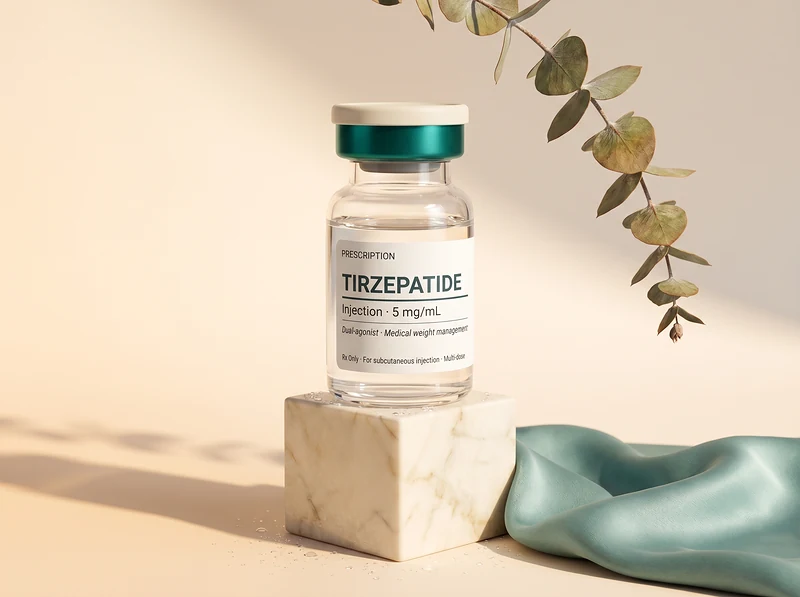

Start with the essential differences.
Semaglutide activates the GLP-1 receptor. Tirzepatide activates both GIP and GLP-1 receptors. These pathways affect appetite and metabolic regulation. A mechanism explains how a medicine acts; clinical trials and your health history help determine whether it is appropriate.
| Question | Semaglutide | Tirzepatide |
|---|---|---|
| Receptor activity | GLP-1 | GIP + GLP-1 |
| Injection schedule | Once weekly, as prescribed | Once weekly, as prescribed |
| Manufacturer medicines | Wegovy · Ozempic | Zepbound · Mounjaro |
| Direct trial result | 13.7% average reduction at 72 weeks | 20.2% average reduction at 72 weeks |
| Compounded versions | Not FDA-approved; not established as equivalent to the studied manufacturer medicines. | |
Brand names identify different products and indications, not interchangeable prescriptions. This guide’s direct comparison concerns weekly injections. Approved oral medicines and compounded dissolving tablets need their own assessment.
Wegovy · prescribing information · Zepbound · prescribing information
What the trials actually found.
SURMOUNT-5 · Direct comparison
The same trial. Different average results.
At 72 weeks in 751 adults with obesity without type 2 diabetes. Maximum tolerated doses: tirzepatide 10 or 15 mg; semaglutide 1.7 or 2.4 mg, injected weekly.
Open-label trial funded by Eli Lilly. It studied manufacturer medicines, not REMEVi compounded preparations. Average results do not predict individual outcomes.
Read SURMOUNT-5 (NEJM, 2025) →Why older trial percentages look different
STEP 1 found average weight loss of 14.9% with weekly semaglutide 2.4 mg versus 2.4% with placebo at 68 weeks. SURMOUNT-1 found 20.9% with tirzepatide 15 mg versus 3.1% with placebo at 72 weeks. Both included lifestyle support, but they were separate trials with different protocols and participants.
STEP 1 (2021) · SURMOUNT-1 (2022)
Use the direct trial for the direct comparison. Do not subtract percentages from separate studies and treat that as a head-to-head result. None of these results establishes what a compounded preparation will achieve.
What the evidence cannot decide for you
These trials do not guarantee a particular amount of weight loss, a deadline, or the same result at a lower dose. They also do not establish equivalence for compounded medicines, which may differ in formulation and instructions. Your clinician should explain both the evidence and the uncertainty for the exact preparation being proposed.
Side effects and safety belong in the decision.
Nausea, vomiting, diarrhea or constipation can occur, particularly during dose increases. Severity and duration vary. Seek medical care for severe persistent abdominal pain, inability to keep fluids down or symptoms of a serious allergic reaction. Do not change your dose on your own.
Both approved weight-management injections carry boxed warnings concerning thyroid C-cell tumors. Their labels contraindicate use with a personal or family history of medullary thyroid carcinoma or MEN 2. Review pregnancy plans, severe gastrointestinal conditions, pancreatitis, gallbladder history and all other medicines with your clinician.
- Semaglutide: the Wegovy label advises stopping at least two months before a planned pregnancy.
- Tirzepatide: the Zepbound label advises a non-oral contraceptive method or an added barrier method for four weeks after starting and four weeks after each dose increase when using oral contraceptives.
- Switching: there is no direct milligram conversion. A prescriber must set the dose and timing; do not combine these medicines or create your own transition plan.
This is not a complete risk list. Read the relevant prescribing information and your own prescription instructions. Safety evidence for an approved medicine does not establish the safety of a compounded preparation.
Compare what you actually pay.
The amounts below are REMEVi’s compounded program prices, not brand prices or insurance estimates. Four weeks is 28 days, not a calendar month. A lower four-week equivalent on a prepaid plan comes with a larger upfront charge.
| Payment term | Semaglutide | Tirzepatide |
|---|---|---|
| 24-Week | $954 upfront for 24 weeks $159 per 4 weeks equivalent | $1,350 upfront for 24 weeks $225 per 4 weeks equivalent |
| 12-Week | $507 upfront for 12 weeks $169 per 4 weeks equivalent | $699 upfront for 12 weeks $233 per 4 weeks equivalent |
| Every 4 weeks | $199 billed every 4 weeks $199 per 4 weeks equivalent | $269 billed every 4 weeks $269 per 4 weeks equivalent |
Program prices include prescribed medication if approved, clinical evaluation and follow-up, shipping and bilingual support. Lab tests required by your clinician for the GLP-1 program are included in your plan price.
You can cancel future renewals without a cancellation fee. Prepaid terms are paid in advance; refund eligibility is governed by the Cancellation & Refund Policy.
Full semaglutide cost breakdown · Full tirzepatide cost breakdown · All plans
Approved brand prices depend on the product, presentation, insurance and savings eligibility. Verify the current manufacturer terms and your coverage rather than comparing an introductory price with a full ongoing program.
Make the choice with your clinician.
A bigger average result does not automatically make one medicine the best fit. Response, tolerability, other diagnoses, access and a sustainable budget all matter. An oral-dissolving option also requires a separate discussion; it is not interchangeable with either injection.
Bring these six points to the conversation
- My diagnoses, past treatment and what I want to improve.
- All medicines and supplements, including diabetes medicines and contraception.
- Pregnancy plans, relevant family history and past digestive or gallbladder problems.
- The full cost I can sustain, including the payment term and renewal rules.
- Which exact preparation is proposed, why it fits my needs and who will dispense it.
- How to report side effects, when to follow up and what would prompt a change.
If a compounded medicine is proposed, ask why an approved medicine cannot meet your needs. Individual dose titration alone does not establish that compounding is medically necessary or legally permitted.
FDA compounding questions and answers · Pharmacy verification resources
Common questions.
Which produced more weight loss in a direct comparison?
In SURMOUNT-5, adults with obesity without diabetes lost an average 20.2% of body weight with tirzepatide and 13.7% with semaglutide at 72 weeks. The trial studied brand products at its maximum tolerated doses. These are averages, not guaranteed outcomes or evidence for compounded preparations.
How do you choose between semaglutide and tirzepatide?
Your clinician considers your diagnosis, history, other medicines, tolerability, preferences and cost. Average weight loss alone does not determine the appropriate treatment.
Can I switch from one medicine to the other?
Switching requires a plan from your treating clinician. There is no direct milligram conversion between these medicines. Do not combine them or choose the new dose or start date yourself.
Which side effects need attention?
Nausea, vomiting, diarrhea or constipation can occur, particularly during dose increases. Severity and duration vary. Seek medical care for severe persistent abdominal pain, inability to keep fluids down or symptoms of a serious allergic reaction. Do not change your dose on your own.
How should I compare costs?
REMEVi semaglutide: From $159 per 4 weeks with the 24-week plan: $954 paid upfront. Or $199 every 4 weeks without a long-term prepayment. REMEVi tirzepatide: From $225 per 4 weeks with the 24-week plan: $1,350 paid upfront. Or $269 every 4 weeks without a long-term prepayment. Four weeks is not a calendar month. Brand products may have different costs depending on insurance, presentation and savings eligibility.
Sources you can read.
- Aronne et al. Tirzepatide as Compared with Semaglutide for the Treatment of Obesity. NEJM, 2025.
- Wilding et al. Once-Weekly Semaglutide in Adults with Overweight or Obesity. NEJM, 2021.
- Jastreboff et al. Tirzepatide Once Weekly for the Treatment of Obesity. NEJM, 2022.
- Wegovy · prescribing information
- Zepbound · prescribing information
- FDA concerns about unapproved GLP-1 drugs
- FDA compounding questions and answers
Medically reviewed by Linda West-Conforti, RN · CA RN #389453 ·