
Is semaglutide the same as Ozempic?
Semaglutide is the active ingredient in Ozempic. The ingredient name does not identify the finished product, route, dose or approval status. A compounded semaglutide preparation is not Ozempic.
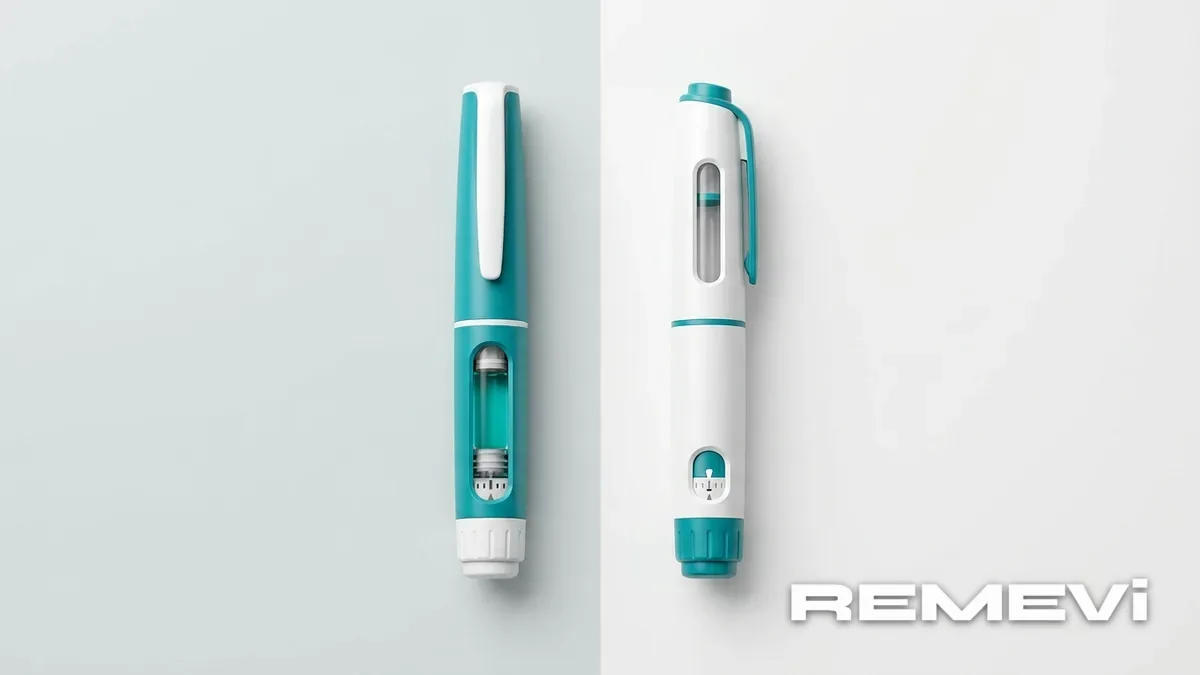
Semaglutide is the ingredient; Ozempic and Wegovy are products containing it. The product’s brand, formulation and indication determine its approved uses and instructions. Sharing an ingredient does not make finished products interchangeable.
This distinction matters before comparing a dose, insurance benefit or trial result. A weekly injection, a daily tablet and a compounded preparation can all mention semaglutide while requiring different decisions.
The table summarizes U.S. indications. It is not a list of medicines offered by REMEVi.
| Name and formulation | What it is | Approved-use summary |
|---|---|---|
| Semaglutide | Active ingredient; a GLP-1 receptor agonist | The ingredient name alone does not specify an approved product |
| Ozempic injection | Weekly semaglutide injection | Adult type 2 diabetes glucose control; cardiovascular-risk reduction with established cardiovascular disease; certain kidney and cardiovascular outcomes with type 2 diabetes and chronic kidney disease |
| Ozempic tablets | Daily oral semaglutide | Adult type 2 diabetes glucose control and major cardiovascular-risk reduction in adults with type 2 diabetes at high risk |
| Wegovy injection | Weekly semaglutide injection | Weight management in eligible adults and adolescents 12+ with obesity; cardiovascular-risk reduction in eligible adults; noncirrhotic MASH with F2–F3 fibrosis in adults |
| Wegovy tablets | Daily oral semaglutide | Weight management and cardiovascular-risk reduction in eligible adults |
| Compounded semaglutide | Individually prescribed compounded preparation | Not FDA-approved; no approved indication or generic-equivalence designation |
Sources: Ozempic injection, section 1, Ozempic tablets, section 1, Wegovy, section 1.
For adult weight management, Wegovy’s label covers obesity, or overweight with at least one weight-related condition. Its cardiovascular indication requires established cardiovascular disease plus obesity or overweight. MASH is a liver disease; the injection’s F2–F3 indication received accelerated approval, with continued approval contingent on confirming clinical benefit. That indication and adolescent weight treatment do not extend to Wegovy tablets.
Ozempic injection has a maximum labeled dose of 2 mg weekly for glucose control. Wegovy injection maintenance is indication-specific: for adult weight reduction, 1.7 mg or 2.4 mg weekly, with 2.4 mg recommended. The current label permits 7.2 mg weekly for adults who tolerate 2.4 mg for at least four weeks when additional weight reduction is clinically indicated.
Daily tablet strengths use a different scale. Ozempic tablets start at 1.5 mg daily and progress to 4 mg, with 9 mg an option for additional glucose control. Wegovy tablets progress through 1.5, 4 and 9 mg to 25 mg daily maintenance. A larger number on a tablet is not a measure of superiority over an injection. Ozempic injection, Ozempic tablets, Wegovy
Your prescriber must manage any switch. See the semaglutide dosing guide and missed-dose guide; even catch-up instructions differ between formulations.
Yes. Semaglutide activates the GLP-1 receptor. GLP-1 is a hormone involved in glucose regulation and appetite; the medication class includes other ingredients such as liraglutide and dulaglutide. Tirzepatide activates both GIP and GLP-1 receptors. The class name does not identify the right medicine for a person. Read how tirzepatide works.
Compounded semaglutide is not Ozempic, Wegovy or a generic equivalent. FDA does not review compounded preparations for safety, effectiveness and quality before marketing. Approved-product studies cannot establish equivalent outcomes for a compounded finished product. FDA says compounding should address medical needs that an available approved drug cannot meet; price alone does not establish that need. FDA: compounded semaglutide and dosing risks
Ask the prescriber why a specific preparation is appropriate and ask the pharmacy to explain its concentration, measurement and storage. Do not transfer branded dosing or tablet instructions to it. Our compounded semaglutide explainer covers the distinction.
Insurance coverage is plan-specific; the ingredient name does not guarantee payment. Use the no-insurance cost guide and current REMEVi pricing for the financial questions. For oral options, see Foundayo versus Wegovy pills.
REMEVi offers care in English and Spanish in 49 states and Washington, DC, excluding Louisiana. Clinician-required GLP-1 labs are included. A licensed clinician reviews eligibility before prescribing. See if you qualify.
This article is educational. Product approval does not establish that a medicine is appropriate for you, and individual results vary.
Semaglutide is the active ingredient in Ozempic. The ingredient name does not identify the finished product, route, dose or approval status. A compounded semaglutide preparation is not Ozempic.
Both contain semaglutide, but their approved uses and dosing differ. Ozempic products have type 2 diabetes indications. Wegovy products have weight-management indications, with additional uses and age limits that depend on the formulation.
No. Both brands have U.S. tablet prescribing information as well as injection information. Weekly injection schedules cannot be applied to daily tablets, and products cannot be substituted milligram for milligram.
No. Compounded semaglutide is not FDA-approved and is not a generic version of Ozempic or Wegovy. Branded-product trials do not establish equivalent results for a compounded preparation.
Free 1-minute quiz, then a 2-minute intake if you qualify. A licensed clinician reviews your information. If prescribed, medication is delivered to your door.
See if you qualifyFree · about 1 minute · no card required