If you take semaglutide for weight loss, the odds are good that at some point you have wondered: can I have a drink? The honest answer is that there is no single answer for everyone. The FDA prescribing information does not include an outright ban on alcohol with semaglutide, but that does not mean the combination is irrelevant. Before you decide, it helps to understand three things, ideally alongside a clinician: how alcohol can intensify digestive side effects, how it affects blood sugar, and why your medical history changes the equation. Wegovy: prescribing information
This article explains pharmacology: how two things interact inside the body. It is not medical advice, and it is not a signal that you can or cannot drink. That decision depends on your health, the other medications you take, and the judgment of a professional who knows your case.
Recommendations and results for approved medicines depend on the indication and product. NIDDK describes weight-management medication as part of a plan that also includes nutrition, activity and follow-up. Source: NIDDK: prescription weight-management medicines
Does alcohol interact with semaglutide?
It is worth starting with what the official label actually says, without inventing anything. The FDA prescribing information for semaglutide describes two documented interactions, and neither one is alcohol. The first is the risk of hypoglycemia when it is used together with insulin or an insulin secretagogue, such as a sulfonylurea. The second is that semaglutide delays gastric emptying and can therefore affect the absorption of other medications taken by mouth. Alcohol does not appear as a contraindication on that label. Wegovy: prescribing information
So why do so many people notice discomfort when they mix the two? The answer is in the mechanism. Semaglutide slows gastric emptying, keeping food and liquid in the stomach longer before they pass into the intestine. Alcohol, for its part, irritates the lining of the digestive tract and can increase acid production. When you pair an irritating substance with a stomach that empties more slowly, you have a recipe for more nausea, reflux, or a heavy, uncomfortable feeling.
The National Institute on Alcohol Abuse and Alcoholism (NIAAA) frames it in general terms: mixing alcohol with certain medications can cause nausea, vomiting, headaches, drowsiness, or loss of coordination, and in some cases can make a medication less effective. It does not single out semaglutide, but the principle applies. And because semaglutide already tends to cause digestive upset during the first weeks, while the body gets used to the dose, adding alcohol in that window is often exactly when it feels worst.
Alcohol and blood sugar
The second point is blood sugar, and the nuance here matters a great deal. Semaglutide helps lower glucose, and according to the FDA label the risk of hypoglycemia rises mainly when it is used together with insulin or a sulfonylurea. Hypoglycemia is when blood sugar drops too low; for most people with diabetes, that means below 70 mg/dL, according to the National Institute of Diabetes and Digestive and Kidney Diseases (NIDDK). Wegovy: prescribing information
Where does alcohol fit in? The NIDDK explains that drinking too much alcohol without enough food makes it harder for the body to keep blood glucose steady. And there is a subtler concern: alcohol can mask the first symptoms of low blood sugar, those early warnings like shakiness, a cold sweat, or feeling lightheaded. If you do not catch them in time, a mild low can turn into something more serious before you react.
For a person taking semaglutide on its own, without other glucose-lowering medications, the hypoglycemia risk is low. But if you combine semaglutide with insulin or a sulfonylurea and then drink, you are stacking several factors that push blood sugar down while also making the warning signal harder to perceive. That specific situation deserves a focused conversation with whoever prescribes for you. It is not an automatic no-drinking rule, but a reason to tailor the plan to your case.
What recent research suggests
There is an interesting twist in the science of the past few years. While many people ask whether alcohol gets in the way of the medication, researchers have been studying the opposite: whether semaglutide can reduce the desire to drink. A randomized clinical trial published in JAMA Psychiatry in 2025 found that a low dose of semaglutide reduced the amount of alcohol consumed in a laboratory setting and lowered weekly craving to drink, compared with placebo, over nine weeks.
This finding is worth reading carefully and not overstating. Semaglutide is not approved to treat alcohol use disorder, and no one should start the medication with that goal or self-medicate. It is an active area of study, not a clinical indication. What it does illuminate is the mechanism: semaglutide acts on the brain’s satiety and reward pathways, the same ones that regulate appetite. That those pathways may also influence the urge to drink fits with how the molecule works. It is science in progress, and the honest answer today is that enough is known to be promising and not enough to draw firm conclusions.
What to ask your clinician
As you can see, the real answer is not a yes or no from the internet, but it depends on your case. That is why the best version of this conversation happens with a clinician who knows your history. If you are going to raise it, these questions help you get the most from the visit:
Do I take other glucose-lowering medications, such as insulin or a sulfonylurea? Does the timing of a drink relative to my weekly dose matter? How much alcohol makes sense in my situation, and what signs should I watch for? Do my current digestive side effects make it better to wait?
At REMEVi, those questions are answered by a physician-led team, with transparent pricing and no insurance games, and a care coordinator who stays with you through the process. If you want to compare treatment options, you can read about semaglutide vs tirzepatide or learn about semaglutide within the program. Compounded semaglutide is a non-FDA-approved preparation made by a state-licensed US compounding pharmacy under an individual prescription. It is not a generic and not the same as Ozempic or Wegovy.
One important note: if you feel that alcohol has become hard to control, that is no cause for judgment or shame, and it is not something to handle in silence. It is exactly the kind of topic worth raising with a professional, who can guide you directly and without lectures.
The molecule behind the medication
To close the loop, it is worth seeing what semaglutide is at the molecular level, because it explains almost everything above. Semaglutide is a GLP-1 receptor agonist: a molecule designed to mimic a natural hormone called glucagon-like peptide-1 (GLP-1), which your gut releases after you eat.
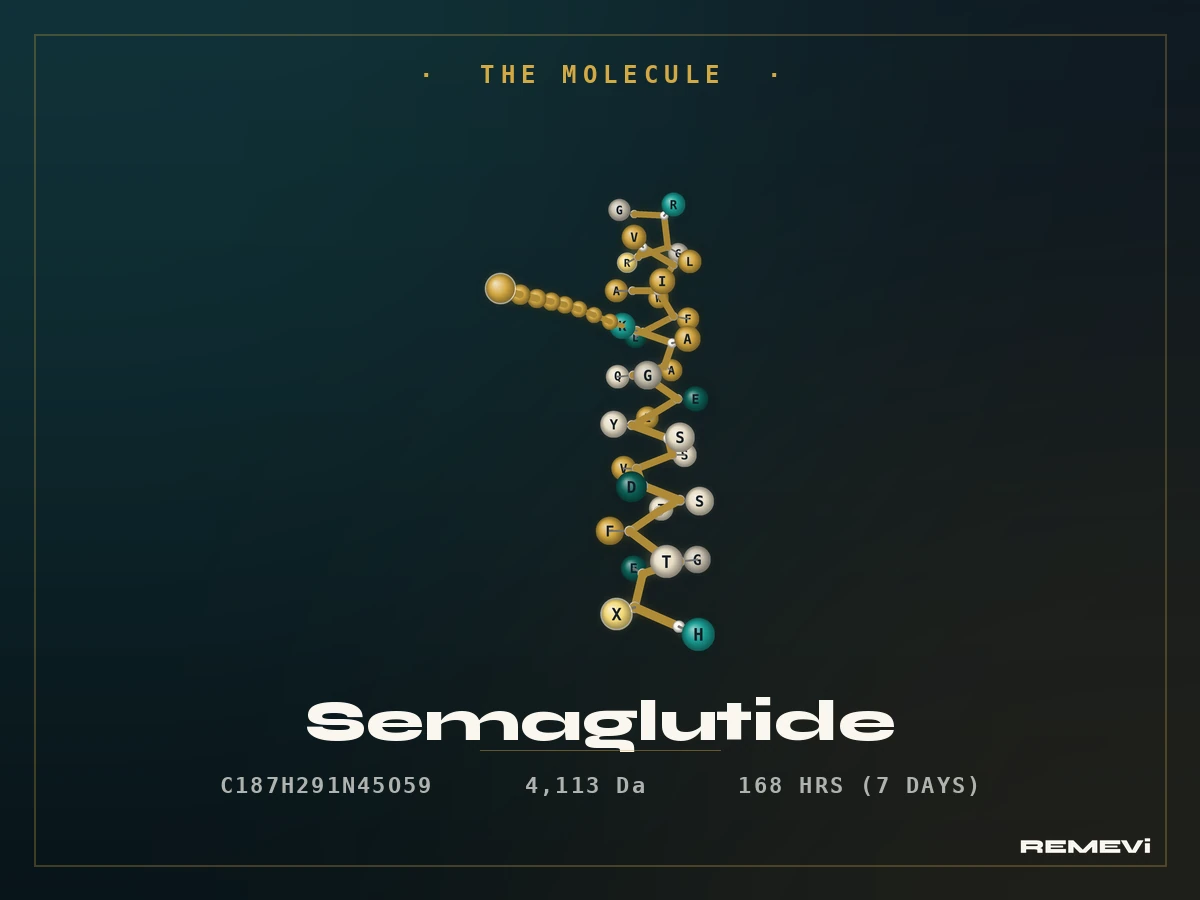 Semaglutide mimics the GLP-1 hormone. It acts on receptors in the brain and digestive tract to slow gastric emptying and strengthen the fullness signal.
By activating those receptors, semaglutide does two things that matter for this topic. In the stomach, it slows gastric emptying, which is exactly what explains why alcohol can sit worse. And in the brain, it strengthens fullness signals and acts on the reward pathways, which is likely why research is now exploring its effect on the desire to drink. It is the same gut-brain signal seen from two angles. If you want to understand how it shows up day to day, our guide to GLP-1 side effects and our explainer on GLP-1 weight-loss injections take the same science-first approach.
Semaglutide and alcohol are not absolute enemies according to the label, but they are not indifferent to each other either. Understanding the why (the gastric emptying, the blood sugar, your history) gives you a far sturdier basis than any general rule for deciding, together with a clinician, what makes sense for you. If you would like to talk it through, you can talk with our medical team, who can review your case.
Real doctors. Real care. remevihealth.com.
This article is for informational purposes only and is not medical advice. GLP-1 medications are FDA-approved for specific indications, and eligibility is determined by a licensed clinician. Individual results vary. Talk with a licensed provider before starting or changing any prescription treatment.