If you’ve ever wondered how long semaglutide stays in your body, here’s the direct answer: it has an elimination half-life of about one week (roughly 7 days), according to the FDA prescribing information. That single number is the key to everything else. It explains why you inject only once a week, how long the medication takes to build up in your system, and what happens when you miss a dose. Wegovy: prescribing information
Here’s the pharmacology of semaglutide in plain language, no filler.
Recommendations and results for approved medicines depend on the indication and product. NIDDK describes weight-management medication as part of a plan that also includes nutrition, activity and follow-up. Source: NIDDK: prescription weight-management medicines
What is a medication’s half-life?
Half-life is the time it takes your body to clear half of the amount of a drug you have in your blood. It’s one of the most useful numbers in pharmacology because it predicts two practical things: how often you need a dose, and how long the drug lingers after you stop taking it.
The logic is simple. A drug with a short half-life of a few hours goes in and out quickly, so it usually needs several doses a day to hold a useful level. A drug with a long half-life sticks around far longer, and a single dose can cover whole days.
Half-life also explains something that trips people up: why a drug doesn’t vanish the day you stop taking it. Each half-life cuts the remaining amount in half, not to zero. After one half-life, half is left; after two, a quarter; after three, an eighth, and so on. It takes about five half-lives for a drug to be considered essentially cleared.
Semaglutide’s half-life (about one week)
Here’s the number that matters. The FDA prescribing information for semaglutide lists an elimination half-life of about one week. With that half-life, semaglutide stays in your circulation for about 5 to 7 weeks after your last dose as it gradually clears. Wegovy: prescribing information
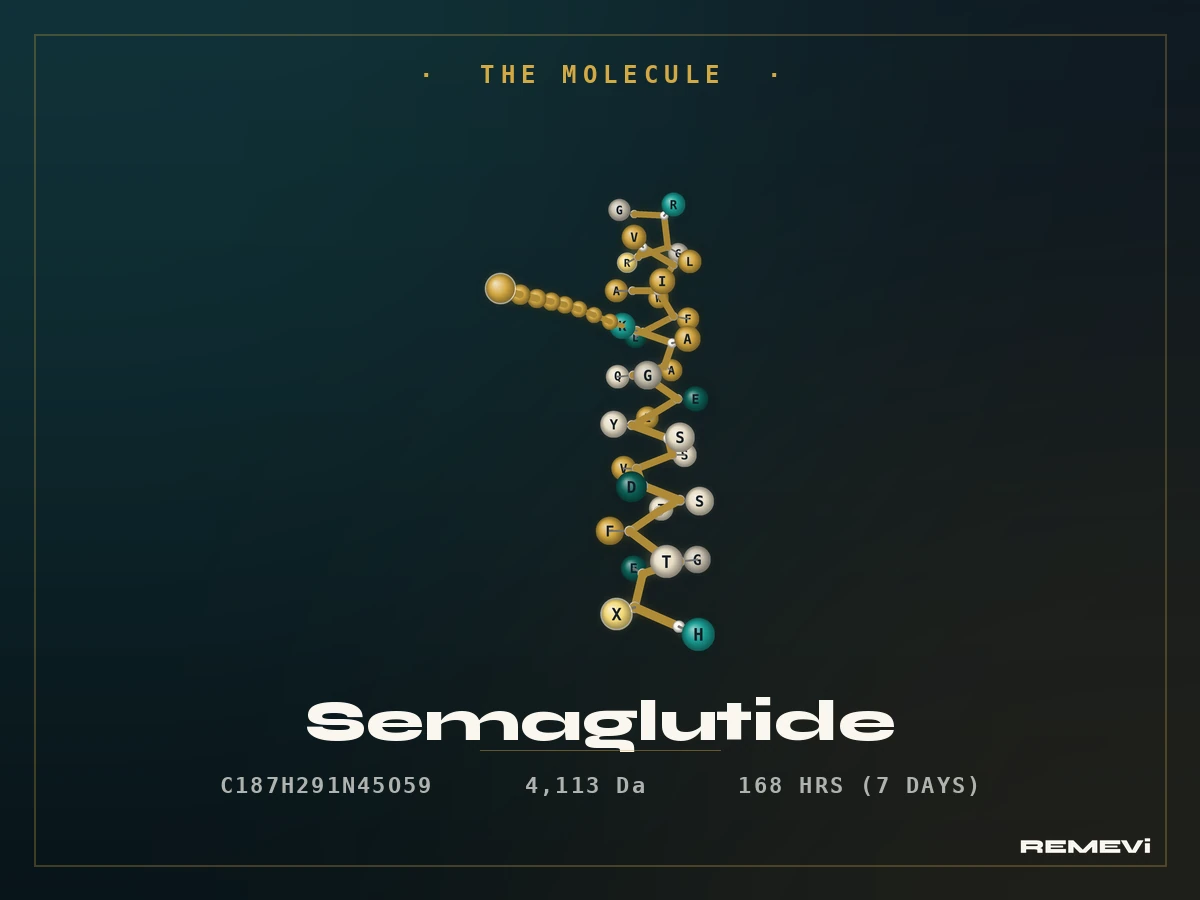 This is semaglutide, the GLP-1 receptor agonist. Its structure is engineered to bind tightly to albumin, a blood protein, which shields it from breaking down quickly and gives it that long half-life of about one week.
Why does it last so long? The semaglutide molecule is modified to stick to albumin, an abundant protein in your blood. Per the FDA label, more than 99% of the semaglutide in your system is bound to albumin. That binding does two things: it slows how fast the kidneys filter it out, and it protects the molecule from the enzymes that would normally break down a small peptide within minutes. The result is a drug that lasts days instead of hours. Wegovy: prescribing information
That long half-life is exactly what makes weekly semaglutide dosing possible. A single injection holds a steady, active level of the medication across all seven days. Peak blood concentration is reached 1 to 3 days after each injection, then it eases down slowly until your next dose. There are no sharp spikes and crashes like you’d get with a short-acting daily pill.
This is the same long-acting principle behind the once-weekly GLP-1 weight-loss injections.
Steady state: why the first few weeks feel different
Here’s a detail that surprises many people: you don’t reach the full level of the medication with your first injection. You get there over time, and that gradual buildup is called steady state.
It works like this. Because semaglutide takes about a week to fall by half, a good portion of your first dose is still around when you inject your second. The third dose adds to what’s left of the first two, and so on. The level in your blood climbs step by step until the amount you inject each week matches the amount your body clears in that same period. At that point you’ve reached steady state.
With a half-life of about one week, that balance takes roughly four to five weeks of consistent dosing at each level. It’s one reason the dose is raised gradually and why the effect on appetite tends to settle in over weeks rather than arriving all at once. Your body is catching up to the pharmacology.
What happens if you miss a dose
The long half-life has a practical upside: a single day’s delay doesn’t wipe the medication out of your system. Because semaglutide stays in your circulation for weeks, one missed dose doesn’t leave you suddenly uncovered.
That said, the exact rule for a missed dose depends on the specific product and your label, so the right source is always your provider or pharmacist. As a general reference, the FDA prescribing information for brand-name semaglutide approved for weight management says the following: Wegovy: prescribing information
- If your next scheduled dose is more than 2 days (48 hours) away, take the missed dose as soon as you can.
- If your next scheduled dose is less than 2 days (48 hours) away, skip the missed dose and resume your usual day.
- If you miss two or more doses in a row, your provider may have you restart at a lower dose to reduce nausea when you resume.
Other semaglutide products use a different window, such as the 5-day rule on some labels, which is exactly why following yours matters. The rule that never changes: don’t take two doses close together to make up for one you missed. When in doubt, message your care team instead of guessing.
Half-life and switching medications
Half-life also matters when you switch from one GLP-1 to another, for example if you and your provider are weighing a move from semaglutide to tirzepatide. Because semaglutide is still present for weeks after your last dose, a switch isn’t like flipping a switch off and on. Your provider factors in that clearance time when planning when to start the new medication and at what dose, so effects don’t stack.
This isn’t something to improvise at home. If you’re curious how the two compare, we have a dedicated guide on semaglutide vs tirzepatide, but any change in treatment is decided and timed by your licensed provider.
It’s worth remembering the difference between the molecule and the brand. Semaglutide is the active ingredient; Ozempic and Wegovy are FDA-approved brands from Novo Nordisk that contain it, and the long half-life is a property of the semaglutide molecule itself. Compounded semaglutide is a separate, non-FDA-approved preparation prepared by a state-licensed US compounding pharmacy under an individual prescription. It is not a generic version of, and is not the same as, Ozempic®, Wegovy®, Mounjaro®, or Zepbound®.
The bottom line
Semaglutide has a half-life of about one week, and that one number explains almost everything practical about treatment: why the injection is weekly, why the medication level takes about four to five weeks to settle at each dose, why one missed dose doesn’t leave you uncovered, and why the drug takes several weeks to leave your body after the last dose. GLP-1 medications are FDA-approved for specific indications, and eligibility is determined by a clinician.
Understanding the pharmacology takes the mystery out of it, but it doesn’t replace the judgment of a professional who knows your case. That’s the REMEVi model: physician-led care, transparent pricing, and pharmacies you can verify. If you have questions about your dose, a switch, or a missed dose, talk to a real clinician at remevihealth.com when you’re ready.
This article is for informational purposes only and is not medical advice. Always follow the specific dosing and storage instructions provided with your medication and by your licensed provider. Compounded semaglutide is a non-FDA-approved preparation. It is not a generic version of, and is not the same as, Ozempic®, Wegovy®, Mounjaro®, or Zepbound®. Compounded preparations have not been clinically studied as finished products. Consult a licensed provider before starting any prescription medication.