Glutathione is an antioxidant made by the body. Its cellular role does not establish benefits from injected preparations, and injectable quality matters because contamination can cause serious harm.
This is a biochemistry explainer: what the molecule is, what it actually does inside a cell, how it is made, and what depletes it. None of it is medical advice or a claim about results.
In August 2026, FDA warned about serious reactions associated with intravenous glutathione compounded from a dietary-supplement-grade ingredient. That alert concerns quality and safety; it does not establish wellness-injection benefits. Source: FDA: injectable glutathione safety alert
What glutathione is
Glutathione, which scientists usually abbreviate as GSH, is a tripeptide: a small molecule made of three amino acids linked in a chain. Those three amino acids are glutamate (the form of glutamic acid), cysteine, and glycine. It is the most abundant non-protein thiol inside our cells, present in nearly every tissue in the body.
The most important part of the whole molecule is the sulfur contributed by cysteine. That sulfur forms a chemical group called a thiol (written -SH), and it is the reactive part that does almost all of glutathione’s work. Once you understand that thiol group, you understand what the molecule is for.
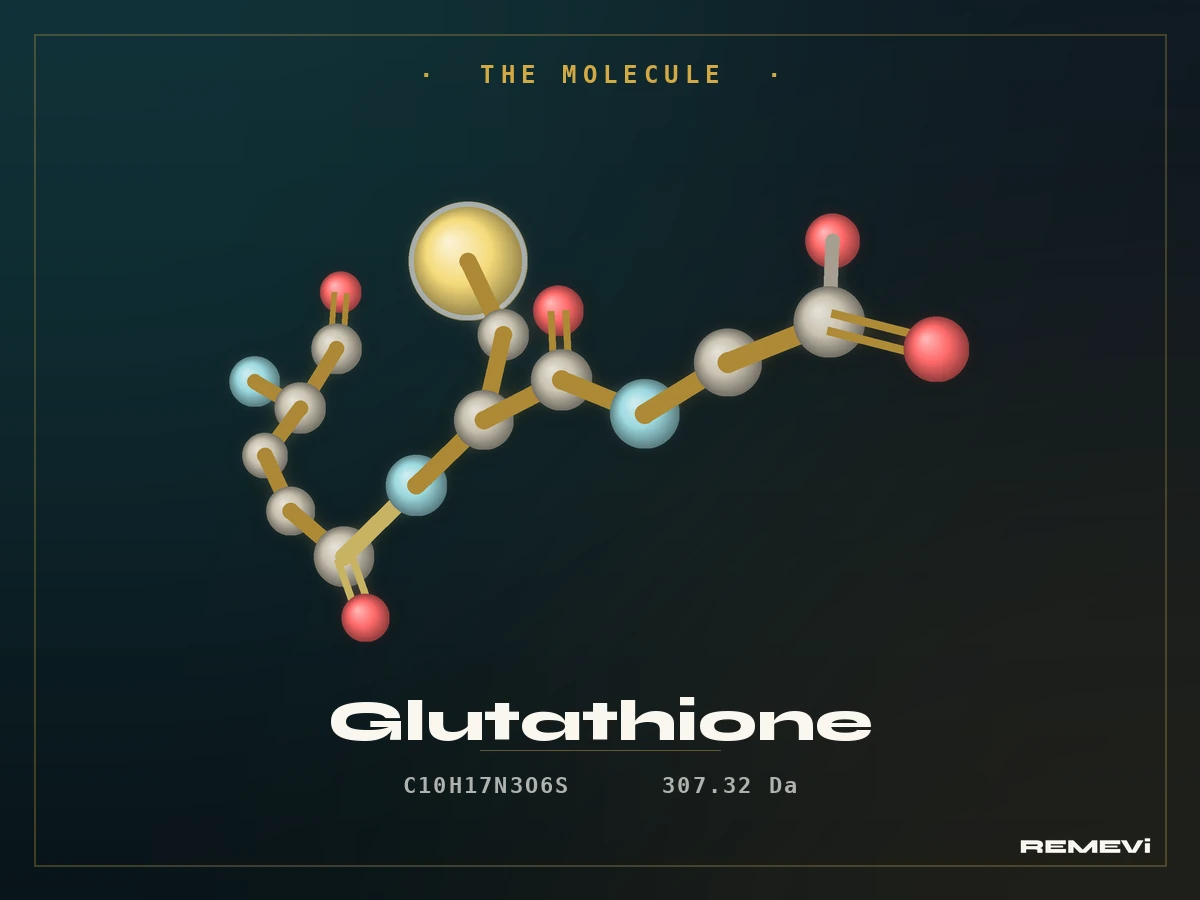 The glutathione molecule: three amino acids (glutamate, cysteine, and glycine) linked in a chain. The thiol group (-SH) on cysteine is the part that neutralizes reactive molecules.
One important point: glutathione is not a nutrient that only arrives from outside. Your body makes it. The liver is the main producer and exporter, but in fact almost every cell synthesizes its own glutathione, because almost every cell needs it daily.
What glutathione does in the body
Glutathione’s central job is to maintain redox balance, the balance between molecules that oxidize and molecules that reduce inside the cell. Normal metabolism constantly generates reactive oxygen molecules, often called free radicals. In controlled amounts they serve useful purposes, but in excess they damage proteins, lipids, and DNA. That excess is called oxidative stress, and glutathione is one of the cell’s main defenses against it.
Glutathione neutralizes those reactive molecules in two ways. It can hand off an electron directly from its thiol group and switch off the free radical. And, most importantly, it works as a cofactor for a family of enzymes called glutathione peroxidases, which use glutathione to convert hydrogen peroxide and lipid peroxides into water and harmless compounds. This second route does most of the antioxidant work.
When glutathione gives up its electrons it becomes oxidized, and two oxidized molecules join to form glutathione disulfide, abbreviated GSSG. Here is the elegant part of the system: the cell does not throw the used glutathione away. An enzyme called glutathione reductase regenerates it back to its active form (GSH) with the help of another molecule, NADPH, which supplies the reducing power. The ratio of active glutathione (GSH) to oxidized glutathione (GSSG) is one of the best indicators of a cell’s redox state and overall health.
It is worth naming a quiet partner here: selenium. The glutathione peroxidase enzymes are selenoproteins, meaning they need a selenium atom at their active site to work. It is a good reminder that the antioxidant system does not rest on one molecule but on a network of nutrients and enzymes working together; glutathione is the central piece, but not the only one.
Glutathione does other things too. The liver uses it, through enzymes called glutathione S-transferases, to bind certain reactive compounds and foreign substances such as drugs and other xenobiotics and prepare them for elimination; this is the biochemical basis of much of how the body processes medications. It also keeps the thiol groups of many proteins in their correct form and takes part in redox signaling inside the cell. For a single small molecule, the to-do list is remarkable.
How glutathione is made, and what depletes it
The cell builds glutathione in two steps, and both consume energy in the form of ATP. In the first step, glutamate and cysteine join to form an intermediate called gamma-glutamylcysteine, thanks to an enzyme known as glutamate-cysteine ligase. This first step sets the pace for the entire production: it is the rate-limiting step, and glutathione itself slows it down once there is enough, a feedback mechanism that prevents overproduction. In the second step, glutathione synthetase adds glycine to that intermediate and completes the glutathione molecule.
Of the three amino acids, cysteine is usually the scarcest, so its availability is what most determines how much glutathione a cell can produce. That is why, in biochemistry, cysteine is considered the ingredient that limits the recipe. There is another detail that explains why the body is so efficient with this molecule: glutathione is recycled. As we saw, glutathione reductase regenerates used glutathione instead of discarding it, so a single pool can neutralize many reactive molecules over time, as long as the cell has NADPH to fuel that regeneration.
What makes glutathione levels drop? Several well-documented factors. The body tends to make less glutathione as it ages. Levels also tend to be lower in people who drink large amounts of alcohol or who smoke, and in certain health conditions: the US National Library of Medicine lists cystic fibrosis, diabetes, and hepatitis, among others. As for sources, glutathione is present in small amounts in some foods, such as spinach, avocado, and asparagus. But more than dietary glutathione, what really matters for the cell is having enough cysteine and a synthesis machinery that works well. One honest piece of context: the FDA has not reviewed glutathione supplements for safety and effectiveness, and much of what the market promises runs well ahead of what the evidence supports.
Glutathione as a prescribed wellness preparation
So far, pure biochemistry. It is worth being just as clear about how glutathione fits into what REMEVi offers, with no promises in between.
Glutathione is part of REMEVi’s Wellness Injections & Drops: a physician-prescribed wellness preparation made by a state-licensed US compounding pharmacy under an individual prescription. It sits within an approach focused on antioxidant support and general wellness; it is not offered with promises of results, and it is not a substitute for a balanced diet and routine medical care.
What matters in practice is that this is a prescribed preparation, not a product you simply buy. A licensed clinician reviews your history and decides whether it makes sense for you, which form to use, and how often. At REMEVi that process is run by a physician-led team, with transparent pricing and a care coordinator who stays with you. You can see all the options on our REMEVi Wellness Injections & Drops page, including NAD+ injections, another preparation built on the same science-first approach.
If you are curious about the biochemistry of another cellular molecule, our explainer on what NAD+ is takes the same approach. A common question is whether glutathione and NAD+ are the same thing: they are not. Glutathione is an antioxidant tripeptide; NAD+ is a coenzyme of energy metabolism. Different molecules, different jobs.
Glutathione is one of the most studied molecules in cell biology, and the most interesting thing about it is not any slogan: it is what it actually does inside a cell. Understanding the thiol group, the balance between GSH and GSSG, and the role of NADPH gives you a far sturdier basis than any promise for deciding, together with a clinician, what makes sense for your health. If you would like to talk it through, you can talk with our medical team, who can review your case.
Talk to a real clinician at remevihealth.com.