Mounjaro contains tirzepatide and is approved for type 2 diabetes; Wegovy contains semaglutide and has weight-management indications. Compare the intended use and studied dose, not just the brand name.
That single fact reframes the whole comparison. What follows is a science-first explainer, not a pitch for one pen over the other. It covers which active ingredient sits behind each brand name, how the two molecules actually work, what the trials measured, and how a licensed clinician decides which one fits a given person. Individual results vary, the research keeps moving, and nothing here is medical advice.
SURMOUNT-5 compared tirzepatide and semaglutide at specific doses in adults with obesity without type 2 diabetes. Its results do not establish compounded-product equivalence or predict your response. Source: SURMOUNT-5 direct comparison
Mounjaro vs Wegovy at a glance
Strip away the branding and the picture gets simpler. Each brand name is really a single active ingredient with a specific FDA-approved use.
Mounjaro is tirzepatide. It is a dual agonist, meaning it switches on two gut-hormone receptors, GIP and GLP-1. The FDA approved Mounjaro as an addition to diet and exercise to improve blood sugar control in adults with type 2 diabetes. In other words, Mounjaro is a diabetes medication.
Wegovy is semaglutide at its 2.4 mg weight-management dose. Semaglutide acts on a single receptor, GLP-1. The FDA approved Wegovy for chronic weight management in adults with obesity, and in adults with overweight who also have a weight-related condition, along with certain adolescents. Wegovy has since gained two more approved uses: lowering the risk of major cardiovascular events (heart attack, stroke, and cardiovascular death) in adults with established heart disease who have obesity or overweight, and, more recently, treating a form of fatty liver disease called MASH with moderate to advanced fibrosis.
Here is the part that trips people up. If you are comparing these two specifically for weight loss, only one of them, Wegovy, is FDA-approved for that purpose. Mounjaro is approved for diabetes. Tirzepatide does have an FDA-approved weight-management brand, but it is called Zepbound, not Mounjaro: same molecule as Mounjaro, different brand name, different approved use. So the cleaner weight-loss comparison is really Wegovy against Zepbound, and Mounjaro against Ozempic on the diabetes side. We unpack both in Mounjaro vs Ozempic and Zepbound vs Wegovy.
How the molecules work
When you eat, your gut releases hormones called incretins that signal to the rest of the body that food has arrived. Two of them matter here. GLP-1 (glucagon-like peptide-1) slows how fast the stomach empties, prompts the pancreas to release insulin mainly when blood sugar is high, and steadies the appetite signals in the brain. GIP (glucose-dependent insulinotropic polypeptide) is a second incretin that also influences insulin release and how the body handles energy and fat.
Semaglutide, the molecule in Wegovy, is a long-acting mimic of GLP-1, so it engages that one pathway. Tirzepatide, the molecule in Mounjaro, engages two at once: it activates the GLP-1 receptor and the GIP receptor together, which is why it is called a dual agonist. The working hypothesis from the research is that engaging both incretin pathways at the same time can produce a larger combined effect on blood sugar and body weight than engaging GLP-1 alone.
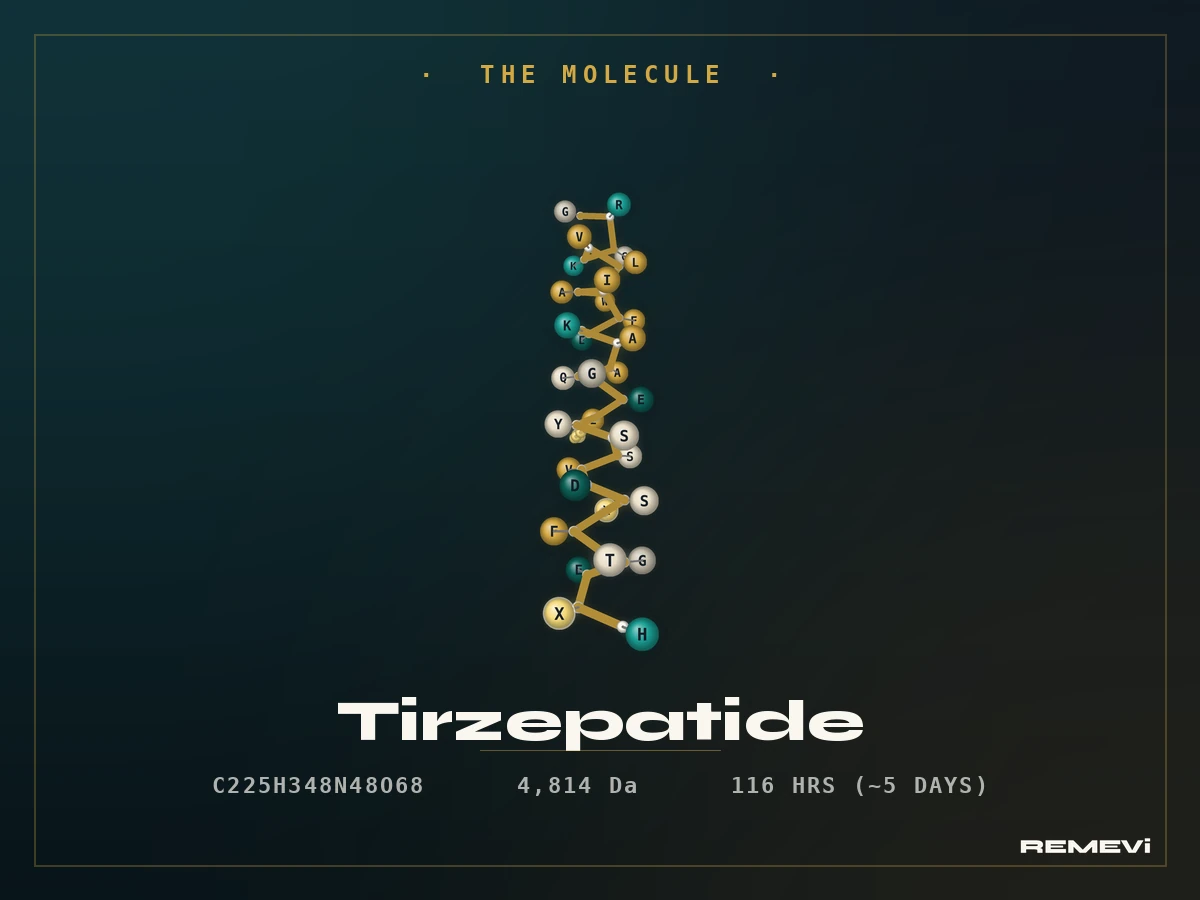 Tirzepatide, the molecule in Mounjaro, is engineered to switch on two incretin receptors, GLP-1 and GIP, while semaglutide, the molecule in Wegovy, engages only GLP-1. That second pathway is the core molecular difference between the two.
What the two share matters too. Both are once-weekly injections given under the skin. Both start at a low dose and step up gradually over several weeks so the body can adjust. And because both act on the GLP-1 pathway, both tend to produce a similar kind of side effect. Mechanism explains why the two can feel comparable in daily use even though they are built differently. It does not, by itself, promise any particular result for any particular person. To go deeper on the dual-incretin molecule, see our explainer on tirzepatide.
What the trials showed
It helps to look at what each molecule did in its own clinical trial, with one caution up front: these were separate studies, run in different groups of people, so the numbers are not a clean head-to-head. They describe each medication against a placebo, not against each other.
Semaglutide 2.4 mg, the Wegovy dose, was tested in the STEP-1 trial in adults with overweight or obesity over 68 weeks. On average, participants taking semaglutide had about a 14.9 percent reduction in body weight, compared with about 2.4 percent on placebo. A large majority of the semaglutide group reached at least 5 percent weight reduction, versus roughly a third on placebo. These are trial averages across a defined population and time window, not a forecast for any one person, and individual results vary.
Tirzepatide, the molecule in Mounjaro, was tested for weight in the SURMOUNT-1 trial in adults with obesity, or overweight with a weight-related condition, over 72 weeks. It is worth noting that SURMOUNT-1 studied tirzepatide for weight, which is the use the FDA later approved under the Zepbound brand, not under Mounjaro. Average weight reductions rose with the dose and landed in the range of roughly 15 to 21 percent across the studied doses, compared with about 3 percent on placebo. Again, these are study averages, not personal projections, and individual results vary.
Because the two trials were separate and enrolled different populations, the honest reading is not that one clearly beats the other by a set number of points. Each molecule produced a substantial average reduction against placebo in its own study. Cross-trial numbers can hint at differences, but they are not a fair comparison, and the medication that actually fits a person depends on far more than a headline percentage.
Side effects and tolerability
Because semaglutide and tirzepatide both act on the GLP-1 pathway, their side-effect profiles look similar. The most common effects reported in the trials were gastrointestinal: nausea, diarrhea, vomiting, and constipation. Most were mild to moderate and clustered early, during the weeks when the dose is being stepped up.
That slow dose escalation is deliberate. Starting low and increasing over time gives the gut a chance to adapt and keeps most people in tolerable territory. A small number of people in the trials stopped treatment because of side effects. Both molecules also carry a boxed warning and are not appropriate for people with a personal or family history of medullary thyroid carcinoma or the syndrome called multiple endocrine neoplasia type 2, which is one reason a clinician screens carefully before prescribing either one. Anyone on one of these medications should stay in close contact with the person managing their care, especially in the first weeks.
How a clinician chooses between them
This is where the brand-versus-brand framing falls apart. The real question a clinician asks is not which pen sounds stronger. It is which medication fits a specific body, history, and goal.
Several things get weighed at once. The first is the target itself: is the primary aim blood sugar, weight, or both? That alone can point toward one molecule and its correctly matched brand. From there a clinician considers your medical history and other medications, how your body tolerates the early titration weeks, cost and access, and how gradually to adjust the dose. Sometimes semaglutide fits best. Sometimes tirzepatide does. Sometimes the answer is neither right now. The molecule that looks strongest on paper is not the right one if a particular person cannot tolerate it or reliably get it.
It is worth being precise about compounded preparations, because that is where a lot of online marketing gets sloppy. Some clinics offer compounded semaglutide or tirzepatide. Compounded semaglutide and tirzepatide are non-FDA-approved preparations prepared by a state-licensed US compounding pharmacy under an individual prescription from a licensed provider. They are not a generic version of, and are not the same as, Ozempic®, Wegovy®, Mounjaro®, or Zepbound®. Compounded preparations have not been clinically studied as finished products. The mechanism and trial science above describes the molecules as studied in the branded products, not a claim about any compounded preparation.
That clinical judgment is what REMEVi is built around. A licensed clinician reviews your health history, current medications, and eligibility before anything is prescribed, our pricing is transparent with no surprise fees, and a care coordinator stays with you through the titration weeks when most questions come up. If you want the deeper molecule-level comparison, our guide to semaglutide vs tirzepatide goes a level further.
The comparison in one line
Mounjaro and Wegovy are two different molecules with two different FDA-approved jobs. Mounjaro is tirzepatide, a dual GIP and GLP-1 medication approved for type 2 diabetes. Wegovy is semaglutide, a GLP-1 medication approved for chronic weight management. For weight specifically, Wegovy is the approved option of the two, and tirzepatide’s weight-approved brand is Zepbound. Both molecules produced meaningful average results in their trials, but averages are not promises, individual results vary, and the medication that fits you is a decision a clinician makes with you, not a winner you pick off a search page.
Your Health. Your Terms. Real doctors. Real care. Talk to a licensed clinician at remevihealth.com.
This article is for general information and does not constitute medical advice. GLP-1 medications are FDA-approved for specific indications, and eligibility is determined by a licensed clinician. Compounded semaglutide and tirzepatide are non-FDA-approved preparations prepared by a state-licensed US compounding pharmacy under an individual prescription from a licensed provider. They are not a generic version of, and are not the same as, Ozempic®, Wegovy®, Mounjaro®, or Zepbound®. Compounded preparations have not been clinically studied as finished products. Individual results vary. Consult a licensed provider before starting any prescription treatment.