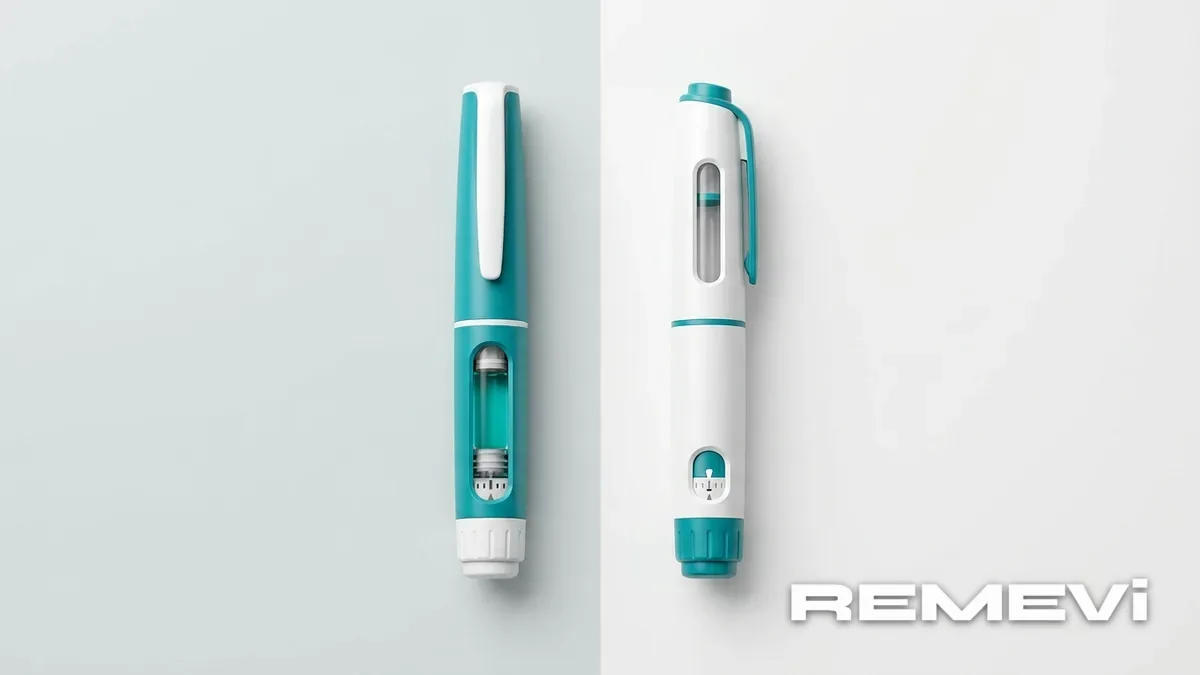
Zepbound and Wegovy are both FDA-approved weekly injections used for weight management, but they are not the same molecule. Zepbound is tirzepatide, which activates two receptors. Wegovy is semaglutide, which activates one. In the head-to-head SURMOUNT-5 trial, tirzepatide produced greater average weight loss at 72 weeks. Individual results vary, and the right choice is a clinical decision.
That is the short version. The longer version is worth reading, because the two brands differ in more than a percentage: they carry different FDA-approved indications, different dosing scales, different side-effect patterns, and, as of 2026, very different self-pay pricing structures. GLP-1 medications are FDA-approved for specific indications. Eligibility is determined by a clinician.
Two different molecules, two different targets
After you eat, your small intestine releases hormones that tell your pancreas to release insulin and tell your brain that you have had enough. Two of those hormones matter here: GLP-1 (glucagon-like peptide-1) and GIP (glucose-dependent insulinotropic polypeptide). Both are incretins, and both are broken down within minutes of being released.
Semaglutide, the molecule in Wegovy, is a GLP-1 receptor agonist. It binds the GLP-1 receptor and activates it, but it is engineered to resist the enzyme that clears the natural hormone, which is why it is dosed once a week instead of continuously. Activating that receptor slows gastric emptying, dampens appetite signaling, and improves the glucose-dependent insulin response.
Tirzepatide, the molecule in Zepbound, does that and one more thing. It is a single peptide that activates both the GIP receptor and the GLP-1 receptor, which is why it is described as a dual agonist. Lilly describes Zepbound as the first and only dual GIP and GLP-1 receptor agonist approved for obesity. GIP signaling appears to add to the appetite and metabolic effect rather than duplicate it, which is the leading structural explanation for the difference the trials keep finding.
A common misreading is that two receptors simply means double the effect. That is not what the biology or the numbers show. GIP and GLP-1 overlap in some of what they do, and GIP signaling in fat tissue and in the brain is still an active research question rather than a settled story. What the dual design appears to buy is a somewhat larger and better-tolerated total effect at doses people can stay on, not an arithmetic doubling.
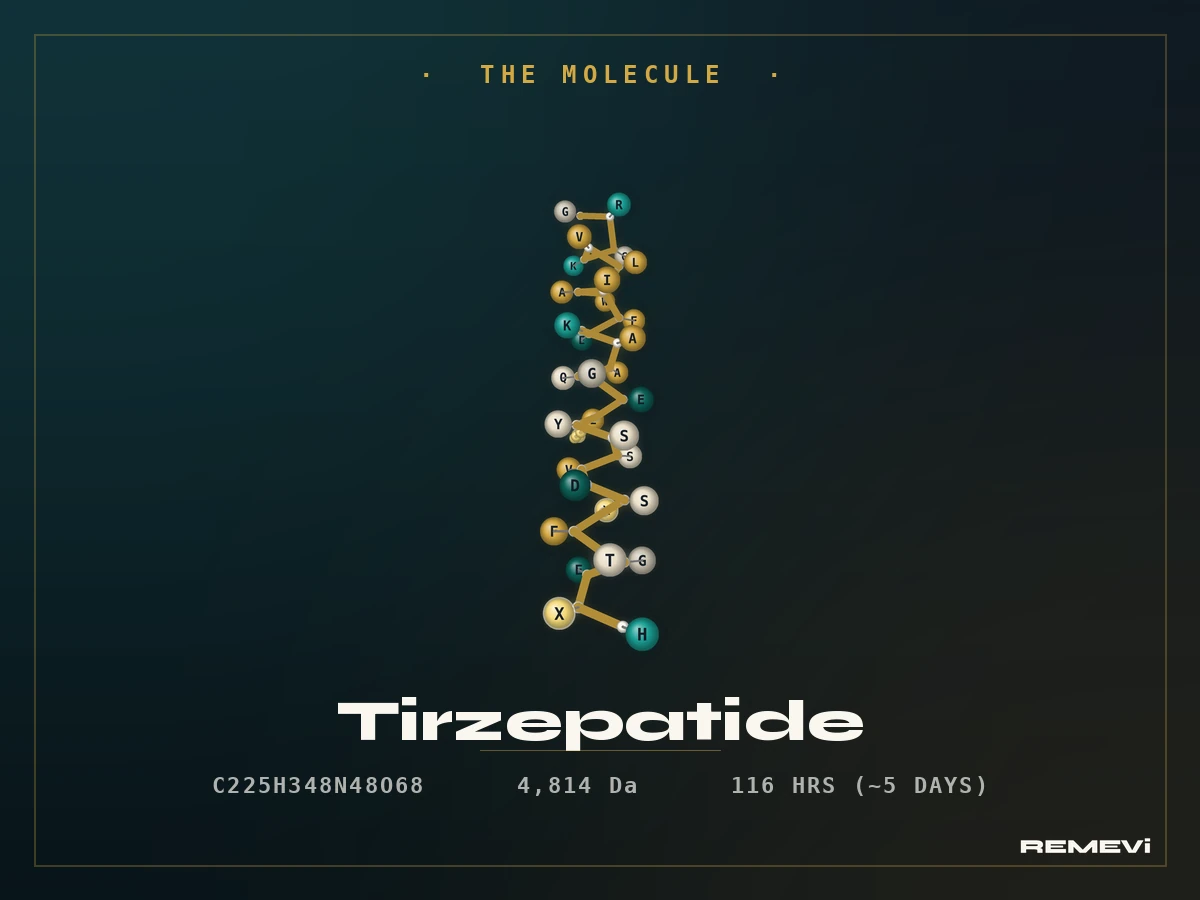 Tirzepatide is a single engineered peptide that fits two different incretin receptors. Semaglutide fits one. That structural difference is the reason the two medications behave differently in the body, and it is the honest answer to “why is one stronger.”
If you want the mechanism explained at the molecule level rather than the brand level, our semaglutide vs tirzepatide comparison goes deeper into the receptor biology.
What the head-to-head trial showed
Until 2025, comparisons between these two medications were indirect: you lined up the results of separate trials run in separate populations and hoped they were comparable. SURMOUNT-5 changed that. It is the randomized head-to-head trial, published in the New England Journal of Medicine (Aronne LJ, Horn DB, le Roux CW, et al. N Engl J Med. 2025;393(1):26-36).
The design: 751 adults with obesity, or with overweight plus at least one weight-related complication, and without diabetes, randomized to the maximum tolerated dose of tirzepatide (10 mg or 15 mg) or semaglutide (1.7 mg or 2.4 mg), injected once weekly for 72 weeks alongside a behavioral support program, across 32 sites in the United States and Puerto Rico.
The results at 72 weeks:
- Average change in body weight: 20.2% with tirzepatide versus 13.7% with semaglutide. Individual results vary.
- Average absolute weight change: 22.8 kg versus 15.0 kg over those 72 weeks. Individual results vary.
- Average waist circumference change: 18.4 cm versus 13.0 cm.
- More participants on tirzepatide reached each threshold the investigators measured, at 10%, 15%, 20%, and 25% of body weight, over the 72-week trial. Individual results vary.
Two caveats matter more than the headline. First, this was a maximum-tolerated-dose design with structured behavioral support over a year and a half, which is not the same as a typical prescription filled at a counter. Second, the investigators reported that weight change was roughly six percentage points smaller in men than in women in both groups, and this trial enrolled more men than most obesity trials, which the authors offered as a reason their overall numbers came in slightly lower than in earlier studies. Averages hide that kind of variation.
The lead investigator has been explicit that the trial is not an argument against semaglutide. Semaglutide also carries randomized outcome evidence that tirzepatide does not yet have, having been shown to reduce the risk of major adverse cardiovascular events, which is a separate question from how much weight comes off.
Side effects compared
Both medications produce mostly gastrointestinal side effects, and in SURMOUNT-5 most adverse events were mild to moderate and clustered during the dose-escalation phase rather than at maintenance. That timing is worth knowing, because it is the part patients most often mistake for a permanent state.
Reported in the head-to-head trial: serious adverse events in 4.8% of the tirzepatide group and 3.5% of the semaglutide group. Discontinuation because of gastrointestinal events ran the other direction, at 2.7% with tirzepatide and 5.6% with semaglutide. Vomiting was reported in 15.0% of the tirzepatide group and 21.3% of the semaglutide group, while injection-site reactions were far more common with tirzepatide, at 8.6% versus 0.3%.
Both manufacturers list the same broad categories of common side effects: nausea, diarrhea, vomiting, constipation, abdominal pain, indigestion, fatigue, belching, hair loss, and heartburn. Both carry a boxed warning about thyroid C-cell tumors observed in rodents, and both are contraindicated in people with a personal or family history of medullary thyroid carcinoma or with Multiple Endocrine Neoplasia syndrome type 2. Both manufacturers also warn about pancreatitis, gallbladder problems, dehydration leading to kidney problems, serious allergic reactions, and the risk of food or liquid entering the lungs during procedures using anesthesia or deep sedation.
Dosing explains a lot of that pattern. Both medications start low and step up on a fixed schedule so the gut has time to adapt, and both are approved across a range of doses rather than at one strength: Zepbound at 2.5, 5, 7.5, 10, 12.5, and 15 mg, with 2.5 mg as a starting dose only and 5, 10, or 15 mg as the recommended maintenance doses; Wegovy pens across 0.25 through 2.4 mg plus a 7.2 mg high-dose pen. Because the two scales are unrelated, a milligram number on one tells you nothing about the other, which is exactly why switching brands requires a new prescription and a fresh titration rather than a matched dose. Pushing the escalation faster than the schedule is the most common self-inflicted cause of a rough first month.
If symptoms are severe or will not go away, that is not something to wait out. Contact the clinician who prescribed the medication.
Cost and coverage in 2026
This is the part of the comparison that has changed the most since these medications launched, and it is where most 2024-era articles are now simply wrong.
For Wegovy, Novo Nordisk publishes a list price of $1,349.02 per package and a set of self-pay prices well below it through NovoCare Pharmacy. As of this update, patients new to the savings offer pay $199 per month for the first two monthly fills of the 0.25 mg and 0.5 mg starting doses, then $349 per month for the 0.25 mg through 2.4 mg pens and $399 per month for the 7.2 mg high-dose pen. Novo Nordisk also now sells Wegovy as a once-daily 25 mg tablet, with self-pay pricing listed at $179 per month for certain doses. People with commercial coverage may pay as little as $25 per month, subject to eligibility and a monthly savings cap.
For Zepbound, Eli Lilly sells single-dose vials directly through LillyDirect self-pay at $299 per month for the 2.5 mg starting dose, $399 for 5 mg, and $449 for the remaining approved doses under its self-pay program. In March 2026 Lilly extended self-pay pricing on the Zepbound KwikPen to major pharmacies nationwide in addition to LillyDirect, starting at $299 per month for the 2.5 mg dose. Under a November 2025 agreement with the US government, Medicare beneficiaries were to pay no more than $50 per month for Zepbound in a multi-dose pen starting as early as April 1, 2026.
Two practical notes. Manufacturer self-pay programs carry eligibility rules, refill-timing requirements, and expiration dates, and both companies reserve the right to change them, so confirm the current terms before you budget around a number. And self-pay dollars generally do not count toward an insurance deductible or out-of-pocket maximum. For a dose-by-dose breakdown that we keep current, see how much Zepbound costs. If you are comparing tirzepatide against the other semaglutide brand, Mounjaro vs Wegovy covers that pairing.
Where compounded preparations fit in
Because brand pricing and prior-authorization friction push people to look for alternatives, compounded preparations come up constantly in this comparison, and they deserve a precise description rather than a marketing one.
Compounded semaglutide and tirzepatide are non-FDA-approved preparations prepared by a state-licensed US compounding pharmacy under an individual prescription from a licensed provider. They are not a generic version of, and are not the same as, Ozempic®, Wegovy®, Mounjaro®, or Zepbound®. Compounded preparations have not been clinically studied as finished products, which also means the SURMOUNT-5 numbers above describe the branded finished products that were studied, and nothing else.
That distinction is not a technicality. It is the difference between a product with a published trial record and a preparation without one, and a licensed provider should walk you through that trade-off before writing anything.
Which one is right for you?
Nobody can answer that from an article, and any page that tells you otherwise is selling something. What an article can do is tell you which questions decide it.
Indication is the first. Zepbound carries an FDA-approved indication for chronic weight management and a second one for moderate-to-severe obstructive sleep apnea in adults with obesity. Wegovy carries an indication for chronic weight management and one for reducing the risk of major cardiovascular events in adults with known heart disease plus obesity or overweight. If you have sleep apnea or established cardiovascular disease, that difference may matter more than any average.
Tolerance is the second. The trial data show a real difference in how the two medications are discontinued: more people stopped semaglutide because of gastrointestinal events, more people reported injection-site reactions on tirzepatide. The medication you can actually stay on is the one that works for you.
History is the third, and it is the one a clinician has to review rather than a form. Thyroid history, pancreatitis, gallbladder disease, kidney function, diabetic retinopathy, pregnancy plans, oral contraceptives, and other medications all change the answer.
REMEVi connects you with a licensed clinician who reviews all of that with you, with care coaching and transparent pricing and no insurance phone tree in between. Talk to a real clinician at remevihealth.com.
Your Health. Your Terms.
This article is educational and is not medical advice. Talk to a licensed clinician before starting, stopping, or changing any prescription medication. Wegovy®, Ozempic®, Zepbound®, and Mounjaro® are registered trademarks of their respective manufacturers and are referenced here for identification and comparison only.