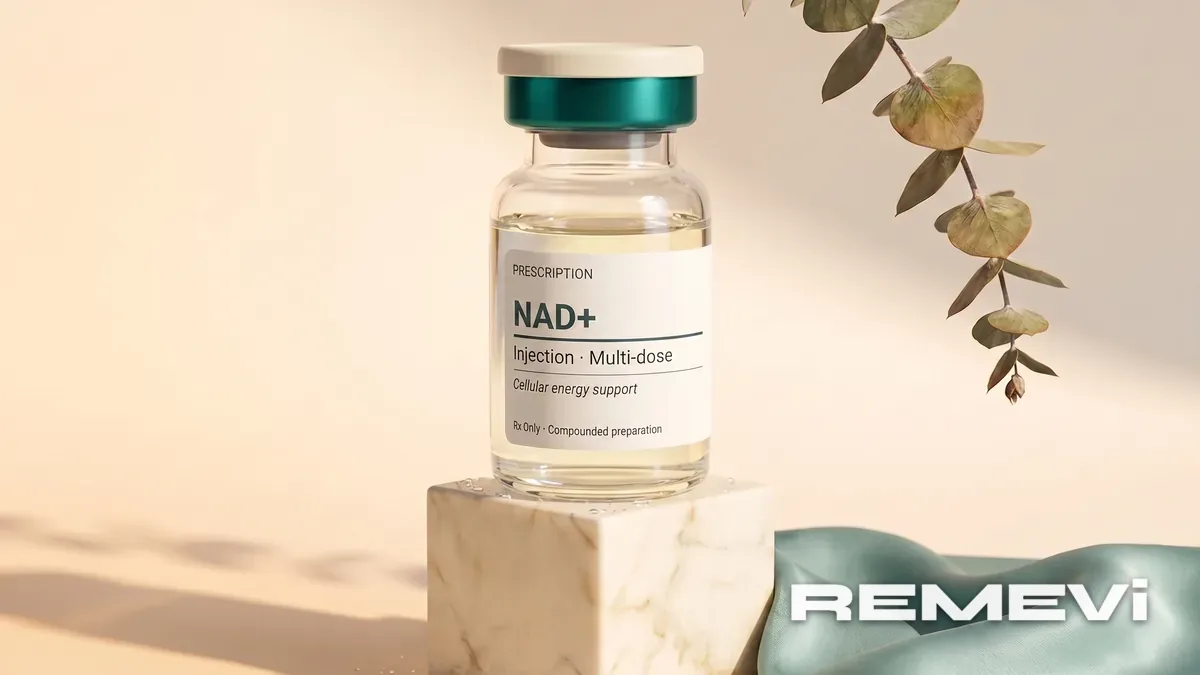
There is no standard NAD+ before and after. Research has not established whether, or when, at-home NAD+ injections change how people feel, and testimonials cannot show that. What people most often notice first are side effects such as injection-site redness or flushing. A licensed provider can set a goal and a time to reassess.
A pilot study of intravenous NAD+ measured metabolites in eight treated participants and three controls; it did not establish clinical benefits or a subcutaneous dosing schedule. Source: NAD+ intravenous pilot study
What NAD+ is, briefly
NAD+ is a coenzyme central to how cells turn nutrients into energy. REMEVi prescribes it for general wellness, after a licensed provider’s individual evaluation — full overview on NAD+ injections, with a science explainer on what NAD+ is.
What you might notice, and what is not established
Stage
What is known or commonly reported
What is not established
First doses
Side effects are what people most often notice: redness or tenderness where they inject, flushing, nausea, tiredness
Whether these early effects say anything about later benefit
Blood levels
NAD+ treatments can raise NAD+ or its metabolites in blood, as a small IV pilot study measured
That higher blood levels change how people feel or age
Over weeks of treatment
Some people report changes in how they feel; these are personal accounts
A timeline, a typical result, or a controlled trial of at-home injections
Review point
Your provider can set a goal and a date to reassess whether to continue
A guaranteed outcome for anyone
How long does NAD+ take to work?
There is no established timeline. Blood NAD+ levels can change soon after a dose, but no study has shown when, or whether, at-home NAD+ injections change how people feel. Any effect people describe varies widely from person to person. A licensed provider can agree a goal with you and a point to review whether continuing makes sense.
What do people notice after NAD+ injections?
Early on, the most common things people notice are side effects such as redness where they inject, flushing or nausea. Some people report changes in how they feel, but those are personal accounts, not controlled evidence, and they are affected by sleep, diet and expectation. Research has not established a standard result.
It’s individualized. Dose, form, and schedule are set per patient, so courses aren’t comparable.
The evidence is still emerging. For many of the outcomes people search “before and after” hoping for, the human data isn’t settled (see NAD+ benefits for the honest breakdown).
Add the fact that compounded NAD+ isn’t FDA-approved as a finished product, and you can see why a stranger’s before-and-after tells you very little about your own situation.
How to read results content critically
Run any “results” content through three filters:
Is it from a licensed provider, or a marketer?
Does it acknowledge that results vary and the product isn’t FDA-approved as a finished drug?
Does it promise a specific outcome? Specific guarantees are a red flag.
A lot of NAD+ before-and-after content fails all three.
What a provider can actually offer
Instead of a transformation promise, a serious program offers an honest, individual assessment: whether NAD+ is appropriate for you, what’s realistic, what they’d monitor, and when they’d reassess. That’s worth more than any gallery.
This article is for general education and is not medical advice. NAD+ prescribed by REMEVi is a non-FDA-approved compounded medication that requires a prescription from a licensed provider after an individual evaluation. Individual results vary.
Injectable preparation safety
FDA has received reports of severe chills, shaking, vomiting and fatigue after NAD+ injectable medicines, with some patients requiring medical care. It warns that food-grade ingredients are unsuitable for sterile compounding. Those reports do not establish a risk frequency for a particular preparation. Source: FDA: ingredients for sterile compounding
Frequently asked questions
How long does NAD+ take to work?
There is no established timeline. Blood NAD+ levels can change soon after a dose, but no study has shown when, or whether, at-home NAD+ injections change how people feel. Any effect people describe varies widely from person to person. A licensed provider can agree a goal with you and a point to review whether continuing makes sense.
What do people notice after NAD+ injections?
Early on, the most common things people notice are side effects such as redness where they inject, flushing or nausea. Some people report changes in how they feel, but those are personal accounts, not controlled evidence, and they are affected by sleep, diet and expectation. Research has not established a standard result.
What does 'NAD+ injections before and after' actually mean?
It usually means how someone feels or measures over a course of treatment compared with their starting point. Because NAD+ is a prescription compounded medication that a provider individualizes, and because the human evidence is still emerging, there is no standard before-and-after that applies to everyone. Individual results vary, so expectations should come from your provider.
Are NAD+ before-and-after photos and testimonials reliable?
Treat them with caution. Testimonials are not controlled evidence, cannot be verified and do not account for sleep, diet, other treatments or expectation effects. They are not a substitute for a clinical conversation. A licensed provider can give you an honest, individual picture of what might be realistic, what they would monitor and when they would reassess.
Why can't a clinic promise specific NAD+ results?
Because compounded NAD+ is not FDA-approved as a finished product and has not been studied as one, and human evidence for many NAD+ claims is still emerging. A responsible provider sets realistic, individual expectations instead of guaranteeing outcomes. A specific guarantee of results is a red flag, not a feature, when you compare NAD+ programs.